
Cooking Together
Cooking builds kids skills, confidence, and promotes an interest in healthy food.
A 2024 study, published in the Journal of Nutrition Education and Behavior, found that cooking programmes for children improved knowledge, confidence, and enthusiasm.
Most studies found that getting children cooking didn’t mean they started eating better. This is counter to our experience at home, where our oldest two daughters definitely started eating better when they learned started to cook themselves.
Key takeaways
- Cooking with your kids improves their knowledge, confidence, and involvement. These are measurable benefits.
- Improvements in actual dietary intake — eating more vegetables, better diet quality — are much harder to achieve and rarely found in studies, except in longer programmes (over six hours of cumulative cooking) or measured two years post-intervention. This would accord with our experience.
- The benefits for skills and confidence are real and worth having for their own sake, not just as a route to better eating.
- Cooking together provides natural opportunities for conversation, maths, science, and practical independence — context that the dietary studies don’t measure.
- Children vary enormously in how they engage with cooking
- Another key takeaway: pressure and performance metrics don’t help, it should be done for fun.
More about the research
The 2024 systematic review, which looked at 23 randomised controlled trials spanning 1998 to 2022, is the most rigorous recent synthesis of the evidence. The headline finding is consistent enough to be useful:
What works reliably: cooking knowledge (understanding ingredients, techniques, food safety), self-efficacy (feeling capable of cooking), and involvement (engagement and interest in the process).
What doesn’t work reliably: improvements in fruit and vegetable intake, overall diet quality, or food preferences. The review found “improvements in dietary intake were rarely achieved despite focus on food acceptance and dietary behaviour.”
There are two caveats that push slightly in a more hopeful direction:
- A separate 2024 review found small vegetable intake improvements, but only for programmes that exceeded six hours of cumulative cooking time.
- A longer-term study found that fruit and vegetable gains did appear — but not until two years after the intervention, suggesting that the habit-building may take time to show up in what children eat.
What the study did show as that cooking together probably builds the foundations of a better relationship with food, but it works slowly and indirectly. Expecting a six-year-old’s vegetable refusals to reverse after one session making ratatouille is setting yourself up for disappointment.
What helps in practice
Based on what the evidence does support, a few things seem to matter:
Making it participatory. Children who cook alongside adults — stirring, tasting, making small decisions — develop more ownership. Make it a fun game you are doing together rather than a set of prescribed tasks. This is less about giving a child a role on a cooking show and more about making the kitchen a shared space.
Sustaining it over time. The studies that did find dietary improvements used programmes lasting well over six hours total. This points to cooking as a habit rather than a one-off activity. Ten minutes of making a simple sauce together on a Thursday is worth more, cumulatively, than an elaborate cooking project once a term.
Keeping the pressure off. Cooking works best as an enjoyable shared activity, not as educational programming or a fussy eating intervention. If a child doesn’t want to eat what they’ve made, they still got something out of making it. Let that be enough.
Matching to age and interest. Toddlers can wash vegetables and tear herbs. Four-year-olds can mix, pour, and roll. Eight-year-olds can learn knife skills with supervision. Teenagers can cook whole meals independently if they’re interested. Forcing the wrong activity at the wrong age makes it feel like a chore.
A note on fussy eating
Cooking together is often suggested as a way to get children to eat foods they currently refuse. The evidence for this is mixed at best. Children’s food preferences are influenced by repeated exposure, not just preparation. A child who has made a meal containing courgettes has been exposed to courgettes — that might count — but there’s no guarantee they’ll eat them.
For UK parents navigating significant fussy eating: the Children’s Food Trust and the NHS both have guidance on picky eating that acknowledges the evidence.
Getting started
If you’ve never cooked with children before, the simplest route in is often the best:
- Something they can eat immediately (pancakes, pizza dough, simple pasta sauces) tends to be more motivating than food that disappears into the fridge
- Something with sensory interest — bread dough to knead, biscuit dough to roll and cut — keeps younger children engaged
- Something they chose — asking what they’d like to make next week costs nothing and builds investment
The goal is a kitchen that feels like a shared space, not a classroom. If the biscuits are slightly burnt and some flour ended up on the ceiling, that’s fine.
Here’s one idea to get started:
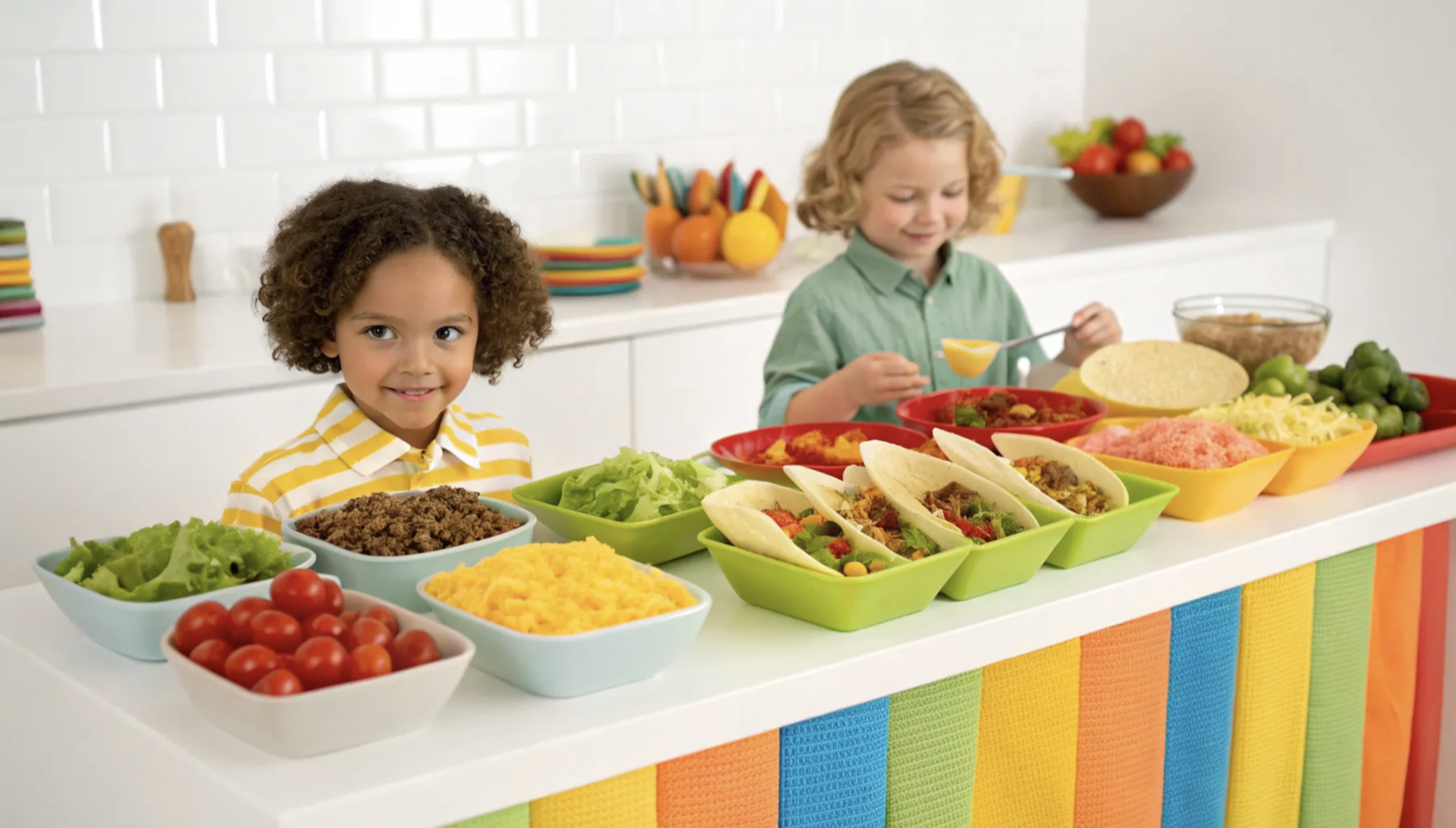
The “Build-Your-Own” Taco Bar
Giving kids a choice reduces dinner-table battles. Set everything out in small bowls and let them assemble.
- The Base: Lean ground beef or turkey seasoned with mild taco seasoning (go easy on the chili powder), or shredded rotisserie chicken.
- The Shells: Offer both crunchy corn shells and soft flour tortillas.
- The Spread: Shredded cheddar, mild salsa, sweet corn kernels, black beans, diced tomatoes, shredded lettuce, and sour cream or plain Greek yogurt.
More research? Check out:
Sources